Reading Comfortably Again: Light, Contrast, Font Size and Reading Glasses
Simple, practical ways to make reading easier on your eyes after 50, from better lamps and bigger text to choosing the right reading glasses.
Do you find yourself holding the newspaper at arm's length? Squinting at medicine labels? Turning on every light in the room to read a recipe?
You're not imagining it. Reading changes as we get older. The good news is that a few small adjustments can make reading comfortable and enjoyable again.
Why reading gets harder
The lens becomes less flexible
Inside your eye is a clear lens that changes shape to focus on things up close. The American Academy of Ophthalmology explains that after about age 40, this lens becomes stiffer and can't change shape as easily.
This is called presbyopia. It's a normal part of aging. The National Eye Institute says everyone gets it, usually after 45, and it usually stops getting worse after about 65.
Common signs include:
- Needing to hold reading material farther away
- Blurry print up close
- Tired or sore eyes after reading
- Headaches after close work
Contrast gets harder to see
The American Academy of Ophthalmology notes that with age, it can be harder to tell apart things that are similar in color. Gray print on white paper may look faint.
Step 1: Light it up
Good light is one of the easiest fixes. The National Eye Institute lists brighter reading lights as a simple way to make reading easier in the early stages of presbyopia.
Tips for better reading light:
- Put the light behind you or to the side, shining onto the page rather than into your eyes.
- Use a lamp near your reading chair, not just a ceiling light.
- Read by a window during the day. Natural light is pleasant and bright.
- Cut the glare. Avoid shiny pages under a bare bulb, and close the blinds partway if the sun hits the page directly.
- Light up hallways and stairs, too. The American Academy of Ophthalmology recommends good lighting in walkways to help prevent falls.
Step 2: Boost the contrast
Contrast means how much the words stand out from the background.
- Choose books and magazines with dark black print on white or cream paper.
- Use a dark pen or marker for shopping lists and notes.
- On a phone or tablet, turn on bold text or high contrast in the settings.
- The American Academy of Ophthalmology suggests increasing contrast on screens and matching screen brightness to the room.
Around the house, using opposite colors can help, too, such as a dark mug for milk or a light-colored plate on a dark tablecloth.
Step 3: Make the words bigger
Bigger print means less strain. The National Eye Institute suggests large-print books and increasing the font size on your computer.
Easy ways to do this:
- Look for large-print editions at your library.
- Increase the text size on your phone, tablet or e-reader.
- Zoom in on web pages.
- Ask for large-print menus or forms. Many places have them.
Step 4: Find the right reading glasses
As presbyopia progresses, most people need glasses or contact lenses to read comfortably.
Over-the-counter reading glasses
The American Academy of Ophthalmology explains that reading glasses can be bought without a prescription. However, the Academy advises that the right strength for you should be determined by an eye doctor.
Bifocals and progressive lenses
If you already wear glasses for distance, you may need lenses that correct both near and far vision. The Academy describes:
- Bifocals, with a near-vision area at the bottom.
- Trifocals, which add a middle zone for things like a computer screen.
- Progressive lenses, which change gradually from top to bottom without a visible line.
Glasses for the computer
If you spend time at a computer, the screen sits farther away than a book. The American Academy of Ophthalmology notes that some lenses are designed for this middle distance, about 20 to 26 inches from your face. Ask your eye doctor if they might help.
Other options
Your eye doctor can also tell you about contact lens options for near vision and newer treatments. Not every option is right for everyone, so it's worth a conversation.
Step 5: Rest your eyes
Even with good light and the right glasses, eyes tire after a long stretch of close work. Follow the 20-20-20 rule: every 20 minutes, look at something 20 feet away for 20 seconds.
Blink fully now and then, too. We tend to blink less when we concentrate.
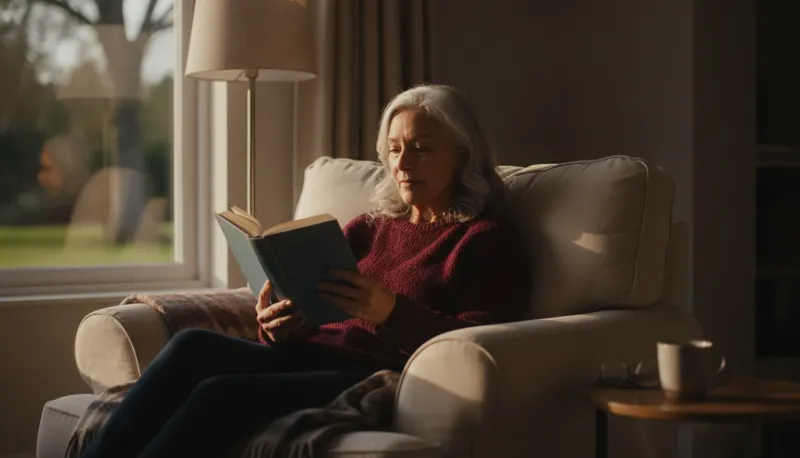
A comfortable reading corner
- A cozy chair near a window
- A lamp beside or behind you
- Your reading glasses in a case on the side table
- Large-print books or a tablet with big text
- A glass of water
- A view across the room for your 20-second breaks
When to talk to your eye doctor
Changes in near vision are normal, but they deserve a check. Talk with your eye doctor if:
- Reading is getting harder, even with glasses.
- You get frequent headaches or eye strain after reading.
- You've been using store-bought readers and haven't had an eye exam in a while.
- Print looks distorted, or straight lines look wavy. The National Eye Institute says wavy lines are a warning sign to see your eye doctor right away.
- Your vision becomes cloudy or colors seem faded.
A dilated eye exam can make sure your reading trouble is simple presbyopia and not something that needs more care.
Sources
- What Is Presbyopia?, American Academy of Ophthalmology
- Presbyopia, National Eye Institute
- 21 Ways Aging Changes Your Eyes, American Academy of Ophthalmology
- Computers, Digital Devices, and Eye Strain, American Academy of Ophthalmology
- Eye Strain and Sleepy Eyes, American Academy of Ophthalmology
- Age-Related Macular Degeneration, National Eye Institute
- Keep Your Eyes Healthy, National Eye Institute